Digital devices—smartphones and tablets—have already become an integral part of our lives, and children know how to use them from a very young age. As a result, the issue of limiting screen time has taken on a new dimension. In January 2026, the American Academy of Pediatrics said limits on screen time alone are not enough, and families should focus on the quality of children’s interactions with digital media, ideally with a family media plan. The report reviewed hundreds of studies from the past 20 years
So the useful question is no longer only “How long?” but “What happens around the screen?” While your kids play Kids Creative Puzzle or Kids Drawings take the described tips.
Ask your child to explain their thinking
In a classic experiment with preschoolers and kindergartners, prompting children to explain improved their problem-solving accuracy, and explaining to their mother produced the greatest transfer to new problems.
Ask “why” and “what if,” not only “how.” One review found that when children were prompted to explain, their explanations often described only the steps and rarely gave a reason why the answer was right. Questions about reasons push thinking deeper.
Encourage children to create their own versions
For example, if your kid plays Kids Creative Puzzle. After completing the puzzle, ask your child not to repeat the colors, but instead ask, “How would you color this character?” or “What would you change?” Why is it important?
Digital tools can lower the barrier to creating. Encourage children to both reflect reality and give free rein to their imagination and creativity. The ability to think outside the box is what fosters creativity and unconventional problem-solving.
Digital colorin pages are less frustrating
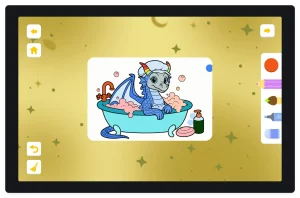
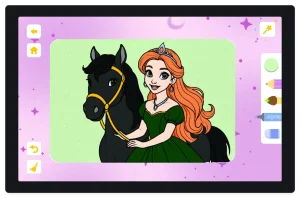
The early years, from age 2 to 6, are a critical period for the development of motor skills and neural connections that form the foundation for future writing and academic success. Research on the development of motor skills in preschoolers shows that early finger control and spatial coordination skills are directly linked to better academic and behavioral outcomes in school.
Digital coloring books offer unique benefits for the youngest users (ages 2–5). Studies on preschoolers’ use of touchscreens show that interacting with tablets helps young children grasp the concepts of color, boundaries, and “finger control” more quickly. Unlike regular paper, where a random movement can ruin the entire drawing, digital tools lower the frustration threshold: the “undo” function and intelligent outline filling allow even a 2-year-old to experience a sense of accomplishment and complete their work.
Create and solve together
Solve a puzzle as a team, compare solutions, and make new ideas from the same image.
Why it works: A 2026 scoping review of parent–child media sessions found that when parents described what was happening and directed the child’s attention, children’s word learning and transfer improved. A large 2026 cohort study of preschoolers found that joint media engagement mattered more for prosocial behavior than screen time or rule-setting did.
Choose your role: Researchers describe three parent roles: spectator, coach, and teammate. Start as a teammate, then step back into a coach role as your child gains confidence.
Combine different types of play
A simple routine: Puzzle → Drawing → Offline activity
- 1Solve a digital puzzle (observe, compare, decide).
- 2Draw or color a new version of the image (imagine, express).
- 3Build, craft, or tell a story inspired by it (make it real).
Each step uses a different skill, and the ending is a real-world object or a story rather than another screen.